A YEAR IN BOOKS
How to make a reading year review that remembers more than totals
At the end of a year, your most recent books come back easily. Spring’s reading is already less clear. Yet there were discoveries, a novel taken on holiday, perhaps an unfinished book with a scene you still remember. A review can help you find them again.
Gather the traces you have: a journal, a list on your phone, photographs or a borrowing history if available. You do not need to have recorded everything in one place to look back.
Buying a book does not necessarily mean you read it, and a borrowed title may have been returned unfinished. Leave uncertainty visible. “Read in spring, approximate date” is more useful than inventing a precise day. A personal review does not require a perfect timeline.
Find the moments behind the titles
Go through the list and pause at books that bring something back. Where were you? Who recommended it? What made you want to continue? Those memories may help recover a reading experience that its title alone no longer suggests.
Choose three or four books you want to remember in more detail. They need not be the best: perhaps one surprised you, another led to conversations, and an unfinished book raised a question you still think about.
Write a few sentences about each before trying to rank them. If two books appealed for entirely different reasons, you do not have to decide which deserves first place. They can sit alongside each other.
What a total can and cannot tell you
The number of books finished may interest you, particularly if you like looking at changes over time. Remember what it does not distinguish: long rereads, essays returned to in pieces, unfinished books and pages you spent time with without reaching the end.
When comparing with the previous year, consider changes in daily life too. A longer commute, a move or fewer free evenings may explain differences. A total alone cannot say whether you enjoyed your reading year.
You might notice other patterns: an author discovered and revisited, a genre you thought you disliked, a period mostly spent with short pieces. Those observations can sometimes make you more eager to continue than a numerical January target.
If you share your review, choose what you want others to see. A few titles with a personal sentence may be enough. Say when an opinion concerns an unfinished book, and keep ending details separate for people who may want to read it.
You need not wait until December either. A review after a holiday or a few months may be easier while memories remain close. You can bring those small notes together later, or simply keep them as separate moments in your reading life.
For your next review, keeping a reading journal through the months will leave a few useful references, even if each entry is only two sentences.
IN READ TODAY
Look beyond the total
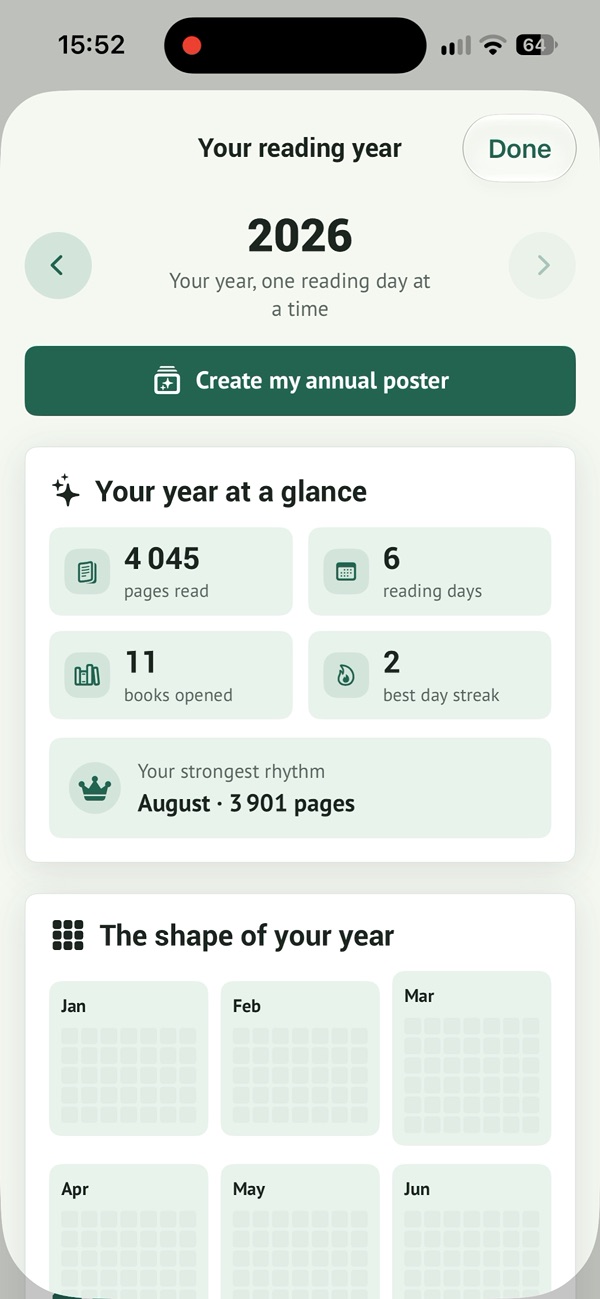
This screenshot shows pages read and reading days among other figures. These describe this demo library; they are not a target to reach. Next, think about which books you would like to return to.
Real app screenshot, interface in English.
To see these ideas in the app, explore our reading tracker for iPhone.
Look back on your year in books.
Read Today keeps your library and progress together. Personalized recaps and complete yearly history are part of ReadToday Plus.
Free to download · In-app purchases